
The TCC story
Four years, one strip at a time.
What began as a quiet experiment became a practice in patience, colour and lightness — and, somewhere along the way, a living.

Why we make
Handmade
Nothing cast, stamped or ordered in. Every coil is rolled at one bench.
Featherlight
Scale you could not wear in metal, at the weight of almost nothing.
Personal
Named in Hindi, Urdu and Sanskrit, because the work comes from somewhere.
Our materials
Paper, and four decisions about it.
Most of what makes a paper piece last is settled before a single coil is rolled — in what you buy, and what you put on it after.
- The paper
- Acid-free paper, cut into strips a few millimetres wide. Acid-free is the part that matters: ordinary paper yellows and turns brittle as the acid in it does its work, over years rather than decades. This doesn't.
- The seal
- Applied by hand, over the whole piece, and the recipe is Shalaka's own — she isn't telling. What it does is the part you can hold us to: it locks the colour, keeps the edges from softening under handling, and takes a piece from fragile to wearable.
- The findings
- Ear wires, hooks and posts are steel. If your ears are particular about metal, wear a pair for an hour before an evening out, the way you would with anything new.
- The weight
- This is the whole argument for paper. Scale that would be an ordeal in metal is nothing here — a piece the size of your palm sits on the ear and then stops asking for your attention.
And if it gets wet?
A sealed piece survives a soaking — caught in the rain, hands washed with it still on. It is not made for swimming or the shower, and it should never be left sitting wet.
How to look after a pieceHandcrafting
The work is the repetition.
A design arrives in an evening. Learning to roll four hundred coils that all hold the same tension takes years — and that consistency, not the drawing, is what makes a piece read as finished from across a room.
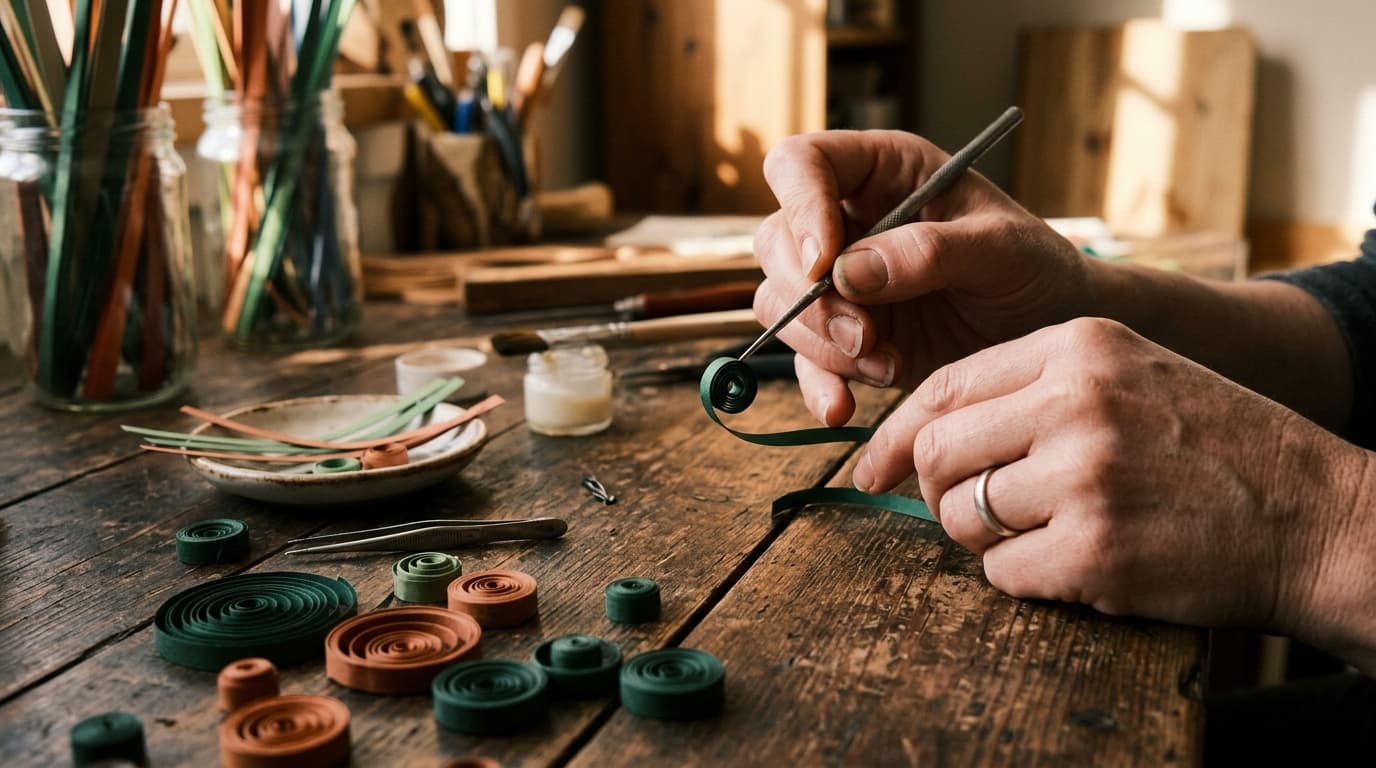
Step 01 of 04
Rolling
Acid-free paper is cut into narrow strips and wound around a fine steel spindle. The coil holds tension without buckling — too loose and it slackens, too tight and it kinks. Getting the same tension four hundred times in an afternoon is the part that takes years.
Step 02 of 04
Shaping
Each coil is pinched into teardrops, petals and paisleys with tweezers, then set beside its neighbours until a mandala closes. Nothing is stamped or cast; if two pieces match, it is because the same hands made them both.
Step 03 of 04
Sealing
The finished piece is sealed by hand. The seal is what turns a fragile thing into a wearable one — it holds colour, resists humidity, and stops the edges softening with handling.
Step 04 of 04
Wearing
Finished with metal findings and weighed. Paper is light enough that scale stops being a problem: a piece the size of your palm still sits on the ear like nothing at all.
All of it happens at one bench in Pune — designed, rolled, sealed, checked and packed by the same person. When a piece is out of stock, it is because it has not been rolled yet.
Commission something of your ownFour years, so far
2022
First piece
A single pendant, rolled at a kitchen table after leaving a corporate job.
2023
First fifty orders
Packed and posted from the same table, one at a time.
2024
First pop-up
The first time anyone picked a piece up before buying it.
2025
Fifty-two families
The catalogue found its shape — named designs, four colourways.
2026
Four years of TCC
Still one pair of hands. A studio, now, rather than a table.